
Open-Cell vs. Closed-Cell Spray Foam for Houston Homes
Open-cell and closed-cell spray polyurethane foam can both insulate and air seal, but they are not interchangeable. Their density, thermal performance per inch, vapor permeance, rigidity, cost, and moisture behavior differ. Choosing between them requires more than asking which product has the higher R-value.
For Houston homes, the decision should account for the roof assembly, available cavity depth, indoor humidity, HVAC location, flood or bulk-water exposure, drying strategy, code requirements, and budget. This guide compares open-cell versus closed-cell spray foam so homeowners can understand the tradeoffs before accepting a proposal.
Open-Cell and Closed-Cell Spray Foam at a Glance
| Characteristic | Open-cell foam | Closed-cell foam |
|---|---|---|
| Structure | Lower-density cells that remain partly open | Higher-density cells that are substantially closed |
| Feel | Softer and more flexible | Rigid and dense |
| Thermal resistance per inch | Generally lower | Generally higher |
| Typical installed thickness | Usually thicker for the same target R-value | Can reach higher R-values in limited depth |
| Vapor permeance | More vapor-permeable | More vapor-resistant as thickness increases |
| Sound absorption | Often better for airborne-sound absorption | Less sound-absorptive due to density |
| Material cost | Generally lower | Generally higher |
Exact values vary by manufacturer and product formulation. The contractor should provide technical data for the specific foam being proposed rather than relying on a generic comparison chart.
What Is Open-Cell Spray Foam?
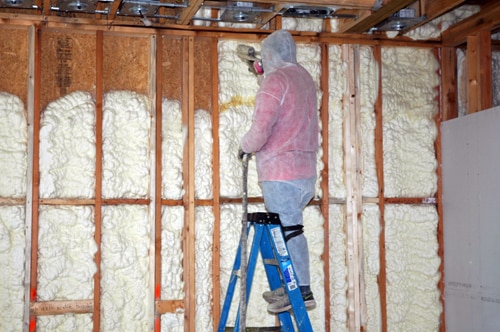
Open-cell foam expands substantially during application and forms a softer material with cells that are not completely sealed. Its expansion can help fill irregular framing cavities, and its flexibility makes it useful in many interior and roofline applications.
Because it provides less thermal resistance per inch than closed-cell foam, open-cell material is typically installed more thickly to reach the intended performance. It remains more vapor-permeable, meaning water vapor can move through it more readily.
Potential advantages of open-cell foam
- Lower material cost in many applications
- Strong air-sealing capability at the required thickness
- Substantial expansion into irregular spaces
- Good airborne-sound absorption
- Greater vapor permeability, which may allow drying through the foam in an appropriately designed assembly
Important open-cell considerations
Vapor permeability is neither automatically good nor bad. It means the roof or wall assembly must be designed with moisture movement and drying in mind. In a hot-humid climate, an unvented attic insulated with open-cell foam may require deliberate humidity control or conditioned-air exchange.
Open-cell foam should not be described as a bulk-water barrier. Roof leaks can pass through or wet the material, and prolonged moisture can damage surrounding wood and finishes. A leak must be repaired rather than relying on foam to manage it.
What Is Closed-Cell Spray Foam?
Closed-cell foam forms a denser, more rigid material with a greater proportion of sealed cells. It generally provides more thermal resistance per inch and becomes increasingly resistant to vapor movement as installed thickness increases.
That can be useful when cavity depth is limited or when the assembly requires stronger vapor control. The specific vapor-retarder classification depends on the product and thickness, so it should be confirmed from manufacturer documentation.
Potential advantages of closed-cell foam
- Higher thermal resistance per inch
- Greater rigidity
- Lower vapor permeance at appropriate thickness
- Useful performance where installation depth is restricted
- Greater resistance to water absorption than open-cell foam
Important closed-cell considerations
Closed-cell foam generally costs more and uses more material by weight. Its low vapor permeance can also reduce drying through the foam. That makes roof condition, moisture content, substrate preparation, and assembly design especially important before installation.
Closed-cell foam is not a substitute for roof waterproofing or structural repair. Although it can add rigidity to an assembly, homeowners should not rely on it to correct damaged decking, framing, fasteners, or storm-related defects.
R-Value and Available Space
Closed-cell foam’s higher thermal resistance per inch can be valuable in shallow framing cavities where the project must achieve a target within limited depth. Open-cell foam can work well where enough cavity space exists for the required installed thickness.
The proposal should state:
- The specific product
- Target thickness
- Declared R-value at that thickness
- Areas receiving foam
- How thickness will be checked
- What happens at framing members and difficult transitions
Average thickness is not enough if large thin areas or missed cavities remain. Consistent coverage and continuity are necessary for both thermal and air-control performance.
Vapor Control and Houston Humidity
Houston’s climate makes moisture management central to the decision. An air-impermeable material can reduce moisture carried by air leakage, but vapor diffusion, roof leaks, indoor humidity, HVAC condensation, and drying potential still matter.
Open-cell foam allows more vapor movement. Closed-cell foam provides greater vapor resistance. The correct choice depends on the complete roof or wall assembly—not on a rule that one product is always safer.
An unvented attic also changes the environment around ductwork and HVAC equipment. The mechanical system may need a strategy for temperature and humidity control inside the enclosed attic. Foam alone does not guarantee suitable attic humidity.
Roof-Leak Detection and Drying
Before either foam is installed against roof decking, the roof should be inspected and active leaks repaired. Wood moisture should be appropriate for application, and stained or deteriorated areas should be investigated.
Open-cell foam may allow water from a leak to become visible sooner, but it can also absorb moisture. Closed-cell foam may resist water entry through the material, yet that can make some leaks harder to identify from inside. Neither product eliminates the need for roof maintenance and exterior inspection.
Sound Control
Open-cell foam’s softer structure generally absorbs airborne sound better than dense closed-cell foam. This can be useful in interior walls, media rooms, offices, or assemblies where reducing ordinary sound transmission is part of the goal.
Neither foam makes a room soundproof. Doors, windows, ducts, framing connections, and other flanking paths must also be addressed for serious acoustic control.
Flood and Bulk-Water Exposure
Houston properties may face plumbing failures, wind-driven rain, or flooding. Closed-cell foam generally absorbs less water than open-cell foam, but the entire assembly must still be inspected after a wetting event. Trapped contamination, damaged substrates, and concealed moisture can remain concerns.
Foam selection should follow the location’s risk, applicable requirements, and the way walls or floors are intended to dry and be repaired. No insulation product makes a building floodproof.
Installation and Occupant Safety
Both open-cell and closed-cell products use reactive chemicals during installation. Trained applicators need appropriate protective equipment, ventilation, and process controls. Uninvolved occupants, pets, and other trades should remain out of the work area and follow the manufacturer’s written re-entry guidance.
Mixing ratio, substrate temperature, moisture, spray-pass thickness, ventilation, and curing conditions all affect the finished material. Strong or persistent odors, discoloration, unusual texture, shrinkage, or separation should be investigated rather than covered.
Depending on the location and applicable requirements, foam may also need an approved ignition or thermal barrier.
Which Foam Is Better for a Houston Attic?
Open-cell foam may be appropriate when the assembly has sufficient depth, sound absorption is useful, the design allows greater vapor permeability, and humidity management has been addressed. Closed-cell foam may be preferred where space is limited, higher thermal resistance per inch is needed, or greater vapor resistance fits the assembly.
The decision should follow an inspection of the roof, decking, framing, existing insulation, ducts, HVAC equipment, ventilation, moisture conditions, and access. A contractor should be able to explain why the recommended product fits those conditions.
Questions to Ask Before Choosing Open- or Closed-Cell Foam
- What exact foam product are you proposing?
- What thickness and R-value will be installed?
- Why does this foam type fit my roof or wall assembly?
- How will the attic manage humidity after installation?
- Does the roof need repairs or moisture testing first?
- How will combustion appliances and exhaust systems be handled?
- What ignition or thermal barrier is required?
- What are the ventilation and re-entry instructions?
- How will installed thickness and adhesion be verified?
- What does the workmanship and product warranty cover?
Get a Home-Specific Spray Foam Recommendation
Read the eight benefits and limitations of spray foam insulation, compare spray foam with traditional insulation, or review our Houston spray foam installation service.
Ultimate Radiant Barrier has served Greater Houston since 2006 and brings 57 years of insulation-industry experience to attic evaluations. Call 713-805-0394 or request a free spray foam estimate.