
8 Benefits of Spray Foam Insulation for Houston Homes
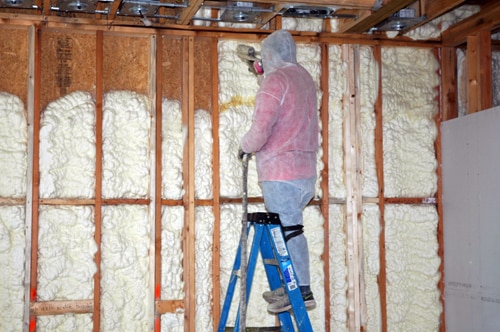
Spray polyurethane foam can combine insulation and air sealing in one installed material. That combination makes it useful in many Houston homes, particularly when the building plan calls for an unvented attic that brings ductwork and HVAC equipment inside the conditioned enclosure.
However, spray foam is not automatically the right answer for every attic. Open-cell and closed-cell products behave differently, roof leaks must be addressed first, humidity control still matters, and installation requires trained professionals, protective equipment, ventilation, and product-specific re-entry procedures.
Here are eight meaningful benefits of spray foam insulation—along with the conditions required to achieve them safely and effectively.
1. Spray Foam Can Insulate and Air Seal
Traditional fibrous insulation slows conductive heat flow but does not necessarily stop air movement. Spray foam expands after application and can form a continuous layer across framing cavities and irregular surfaces. When installed at the required thickness without gaps or defects, it can act as both insulation and an air-control layer.
Air sealing matters because uncontrolled air movement can carry heat and moisture through cracks, penetrations, top plates, and other openings. Reducing that leakage can make the building enclosure easier to heat, cool, and manage.
This benefit depends on continuity. Thin areas, missed framing intersections, cracks, shrinkage, or openings created by later electrical and mechanical work can compromise the air barrier.
2. It Can Reduce Heat Flow Through the Building Envelope
Spray foam provides thermal resistance that slows heat flow through the surfaces where it is installed. Closed-cell foam generally provides more thermal resistance per inch than open-cell foam, while open-cell foam is typically applied more thickly to reach a given target.
In Houston, roofline applications are often considered because intense solar heat affects the roof assembly for much of the year. The correct insulation thickness and assembly depend on the product, building design, applicable code, climate, and whether the attic will remain vented or become unvented.
Do not judge an installation only by how completely the foam appears to cover the surface. The proposal should state the foam type, target thickness, intended R-value, and areas included in the project.
3. A Properly Designed System Can Improve Comfort
Rooms beneath hot attics can be difficult to keep comfortable, particularly when the roofline, attic floor, ducts, and ceiling penetrations allow substantial heat or air movement. A well-designed spray-foam assembly can reduce those loads and support more consistent indoor temperatures.
Comfort improvement varies. Spray foam cannot correct every cause of a hot room, such as inadequate HVAC capacity, poor duct balance, solar gain through windows, or missing return-air pathways. The home should be evaluated as a system rather than assuming insulation alone will solve every comfort complaint.
4. It Can Bring Attic Ductwork Into a More Tempered Space
Many Greater Houston homes have air handlers and ducts in the attic. In a traditional vented attic, that equipment operates in an environment that can become extremely hot and humid. When spray foam is used to create a correctly designed unvented roof assembly, the attic may become part of the conditioned or indirectly conditioned enclosure.
That can reduce the temperature extremes surrounding the duct system and help limit heat gain through duct surfaces. It does not eliminate the need for sealed, properly sized, and insulated ducts. The attic may also require a deliberate method of humidity control or conditioned-air exchange.
5. It Can Support Moisture Control When the Assembly Is Correct
Air leakage can transport significant moisture into building cavities. Because spray foam can form an air barrier, it may reduce that moisture pathway when installed continuously.
That does not mean spray foam “prevents mold” or waterproofs a roof. Roof leaks, plumbing leaks, HVAC condensation, indoor humidity, and exterior water intrusion must still be controlled. Open-cell foam is more vapor-permeable than closed-cell foam, and the two products require different moisture considerations.
In Houston’s hot-humid climate, an unvented attic must be designed with attention to roof construction, foam type, vapor movement, indoor humidity, HVAC operation, and drying potential. Foam should never be used to conceal wet decking or an unresolved leak.
6. Open-Cell Foam Can Help Reduce Sound Transmission
The softer, more flexible structure of open-cell spray foam can absorb some airborne sound when used in suitable wall, floor, or ceiling assemblies. This may help reduce sound movement between rooms or from outside sources.
Spray foam does not make a room soundproof. Flanking paths through doors, windows, framing, ducts, and penetrations still matter. Homeowners with serious acoustic goals should evaluate the entire assembly rather than relying on insulation alone.
7. Properly Installed Foam Can Remain in Place Without Settling
Spray foam adheres to the substrate and does not settle in the same way loose-fill insulation can. That can help maintain continuity in complex framing cavities when the foam is mixed, applied, and cured correctly.
Durability depends on installation quality and later conditions. Off-ratio material, unsuitable substrate temperature or moisture, improper lift thickness, shrinkage, fire, prolonged water exposure, pests, or renovation work can damage the installation. Foam should be inspected if odors, separation, cracking, moisture, or other abnormalities appear.
8. Open-Cell and Closed-Cell Products Offer Different Options
Open-cell foam is lower-density, more flexible, and generally more vapor-permeable. It is often used where thicker cavity fill and sound absorption are useful. Closed-cell foam is denser, provides more thermal resistance per inch, and can offer greater vapor resistance depending on installed thickness.
Neither type is universally superior. The choice should consider:
- Where the foam will be installed
- Available cavity depth
- Required thermal performance
- Roof and wall drying strategy
- Flood or bulk-water exposure concerns
- Interior humidity and HVAC design
- Ignition- or thermal-barrier requirements
- Budget and project goals
Our guide to open-cell versus closed-cell spray foam explains these differences in greater detail.
Important Spray Foam Limitations
Spray foam can be highly effective, but it should not be sold as a cure-all.
- It does not repair a leaking roof.
- It should not be installed over wet, dirty, or unsuitable surfaces.
- It does not replace proper HVAC sizing, duct design, or humidity control.
- It is not a substitute for pest exclusion and remediation.
- It may make roof-deck leaks harder to detect from inside the attic.
- It can complicate future wiring, plumbing, roof, or structural work.
- Exposed foam may require an approved ignition or thermal barrier depending on the location and applicable requirements.
A proposal should explain how the complete assembly will function, not merely how many inches of foam will be sprayed.
Installation Safety and Re-Entry
Spray polyurethane foam uses reactive chemicals during application. The U.S. Environmental Protection Agency advises that occupants and workers not involved in installation should leave the area and follow the manufacturer’s re-occupancy guidance. Applicators need appropriate protective equipment, ventilation, training, and workplace controls.
Re-entry time is product- and condition-specific; it should not be guessed. Before work begins, homeowners should receive the product information, safety data, ventilation plan, and written instructions for when people and pets may safely return.
Future contractors should also know where foam is present. Cutting, grinding, welding, or other hot work on or near polyurethane foam can create additional hazards.
Is Spray Foam Right for Your Houston Home?
Spray foam may be a strong option when the home needs both air sealing and thermal insulation, the attic design supports an unvented assembly, and HVAC and moisture management are addressed. Fiberglass may be the better value when the attic should remain vented, easy inspection and future access are priorities, or the home does not need a roofline foam system.
Compare the options in our spray foam versus traditional insulation guide, or review our Houston spray foam insulation service.
Request a Spray Foam Assessment
Ultimate Radiant Barrier has served Greater Houston since 2006 and brings 57 years of insulation-industry experience to attic evaluations. We assess the structure, existing insulation, roof condition, ductwork, ventilation, and project goals before recommending open-cell foam, closed-cell foam, fiberglass, or another appropriate solution.


