Mon - Sat 8AM - 7PM

Hot rooms, an AC that never cycles off, or insulation you have never actually looked at. Tell us which and we will come take a look.
No obligation and no pressure. Prefer to talk? 713-805-0394
We install CertainTeed fiberglass batt, made in America. It is what goes into every batt job we do, and that is a deliberate choice rather than whatever the supply house had that week.
What it gives us to work with:

CertainTeed batt comes both ways and they are not interchangeable.
Unfaced batt is manufactured slightly wide so it friction-fits into a cavity and holds itself there. It carries no vapor retarder of its own, so it belongs where a separate retarder is doing that job, or where no retarder is required at all.
Kraft faced batt has the vapor retarder built in — an asphalt-applied kraft facing rated at one perm or less, with stapling flanges along the edges for face or inset stapling. That is the usual answer inside a framed wall.
Choosing wrong is not a small mistake in a climate like ours, which is why we settle it at your house rather than over the phone.
Batt sits between the joists instead of burying them, so the bay stays a bay. If you plan to lay a floor over part of the attic and actually store something up there, that decking has somewhere to land.
Exterior walls for temperature, interior walls for quiet. Kraft faced batt staples straight into the stud bay with its vapor retarder already attached, which is why it is the standard answer once drywall is off.
Before the drywall goes on is the cleanest time to insulate anything. Additions, garage conversions and bonus rooms all get framed and left open, and that open framing is exactly what batt is cut to fill.
Plenty of homes end up with both, in different places. Blown-in is faster and cheaper per square foot across an open attic floor, and it settles into gaps without anyone crawling into the corners to place it. Batt wins wherever the cavity needs to stay defined, or where you may come back later to run a wire or add a vent.
Which one you need depends on what your attic is actually shaped like, so we look before we recommend. An open attic with clear decking and no storage plans points one way. A half-floored attic with the air handler sitting in the middle of it points another. If you already know you want the blown product, we cover it on our blown in attic insulation page.
The Department of Energy range for an attic here is R-30 to R-60 if you are starting from bare joists, and R-25 to R-38 if you already have three or four inches up there. The full zone table is on our insulation information page.
Reaching those numbers in batt is a question of depth. An R-30 batt is built for a cavity around eleven inches deep, and most attic joists are shallower than that, so the upper end of the range usually means a second layer laid across the joists rather than a thicker batt crammed into the bay.
What an R-38 batt actually delivers once it is compressed into a 2×10 cavity.
This is worth understanding before you hire anyone, us included.
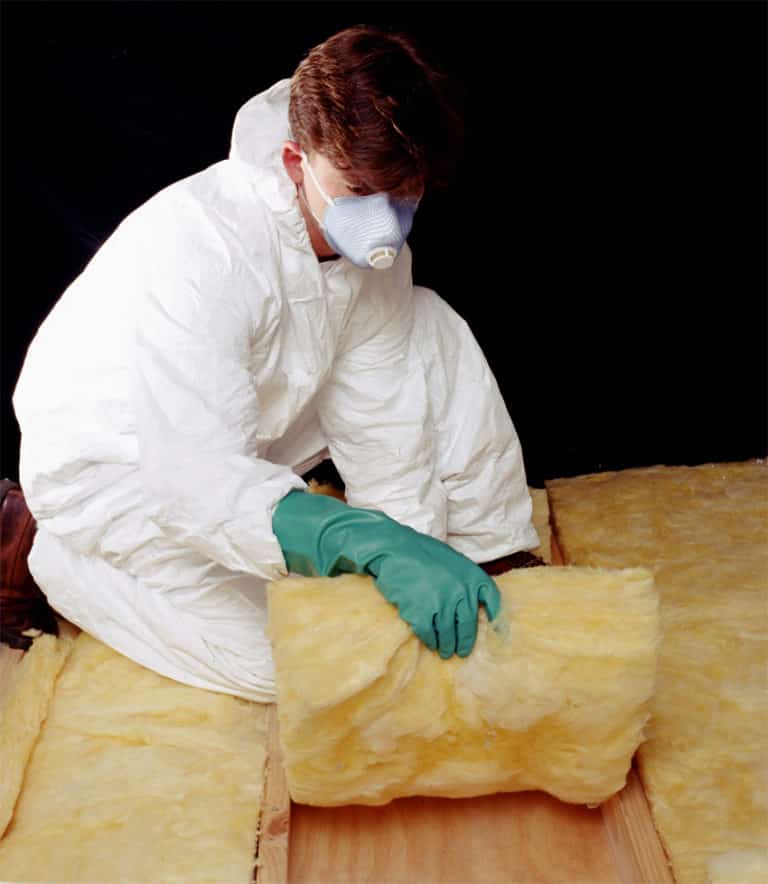
Fiberglass batt earns its rated R-value at its labeled thickness, uncompressed. You bought R-38, you are living with R-29, and nothing about the attic looks wrong from the hatch. The same thing happens with batts cut short around a brace, stuffed in behind wiring instead of split around it, or left with a gap at the end of a joist bay. Air moves through a gap rather than through insulation, so a small gap costs more than its size suggests.
None of that shows up on a power bill in a way you can trace back to it. It just underperforms quietly for as long as it is up there. So we cut around obstructions instead of through them, split batts around wiring, and fill each bay end to end.
When exposed to moisture, fiberglass batt insulation neither absorbs nor holds water. If fiberglass insulation does get wet during or after installation, installers should visually inspect it on all six sides for contamination. If the material appears free of visible defects, installers must dry it thoroughly to restore its full R-Value. Once the area surrounding the insulation has also been inspected, cleaned and fully dried, the fiberglass insulation can be reinstalled and will regain its original R-Value.
Where insulation has been soaked, contaminated or damaged past that point, it comes out instead. That is a separate job and we cover it on our insulation removal page.
When we come to your home for your free estimate, our technicians will go over all options with you and see which is the best fit for you, your home and your budget. All in all, we want you to be happy with your purchase as well as the work performed.
If you’re looking for an experienced and reliable Insulation contractor in Houston, give us a call today and let’s get your home feeling right and your bills reduced!
Batt arrives as pre-cut panels sized to the framing and leaves the cavity defined. Blown-in is loose fiberglass that fills an irregular space by covering it. Batt is the better answer wherever the cavity has to stay usable; blown-in is usually faster and cheaper across an open attic floor.
Not always. It depends on the condition of what is already up there, which is what the free assessment is for. Insulation that has been soaked, contaminated or damaged needs to come out first — see our insulation removal page for that side of the work.
Yes, and that is one of the main reasons to choose batt. It installs between the joists rather than burying them, so a flooring substrate has somewhere to sit if you intend to make more use of that space.
Batt needs an open stud bay, so in a finished home it goes in where the drywall is already off — a remodel, an addition, a garage conversion. If your walls are closed and staying closed, we will talk you through the other options when we come out.
Yes. Fiberglass absorbs sound wherever it is installed, which is why batt earns its place in interior walls between bedrooms, around media rooms and under bonus rooms — not only in the attic.
Fiberglass is inorganic glass fiber. It does not absorb moisture and it will not rot, mildew or corrode, so there is nothing in the material itself for mold to feed on. What matters is the condition of the attic around it, which is part of what we check.