
Radiant Barrier Foil vs. Spray Coatings for Houston Attics
Houston homeowners researching radiant barriers often encounter three very different products presented under similar names: foil radiant barrier, spray-applied reflective coatings, and roof decking with a factory-applied reflective surface. Each can affect radiant heat transfer, but they are not interchangeable and should not be compared using appearance or marketing claims alone.
The most important questions are how reflective performance is documented, whether the product faces an open air space, how consistently it can be installed, and whether it fits the existing attic. This comparison explains the practical differences between radiant barrier foil and spray coatings for Houston homes.
What Makes a Product a Radiant Barrier?
A radiant barrier is a low-emissivity surface installed so that it faces an open air space. Rather than relying primarily on material thickness, it reduces radiant heat transfer by reflecting radiant energy and emitting less heat toward the cooler surfaces across that air space.
That air space is essential. A shiny material compressed between two solid layers does not perform the same way it does when its reflective face is exposed to an attic cavity. Product specifications, tested emissivity or reflectivity, and installation configuration matter more than whether a surface merely looks metallic or reflective.
Foil Radiant Barrier
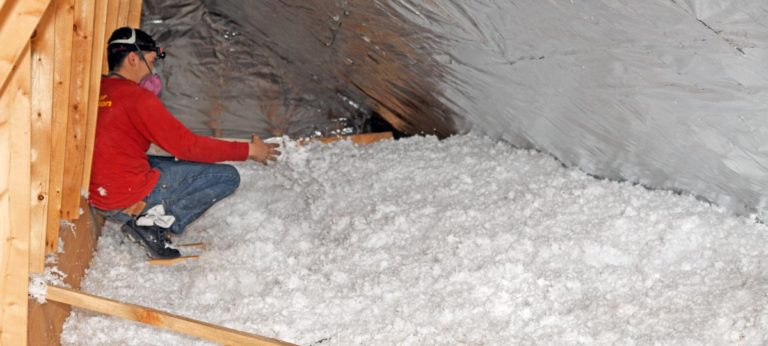
Foil radiant barrier is generally made with a manufactured aluminum reflective surface supported by a reinforcing layer. In an existing vented attic, it is commonly attached beneath the roof rafters so the foil faces the attic air space.
Advantages of foil
- Consistent manufactured surface: The reflective face is produced under controlled conditions rather than created by the thickness and uniformity of a field-applied coating.
- Documented reflectivity: Quality foil products provide specifications for reflectivity or emissivity.
- Visible coverage: Installers and homeowners can more easily see gaps, tears, sagging, or incomplete areas.
- Suitable for many existing attics: Foil can often be installed without removing clean, dry, serviceable insulation.
- Durability: Properly secured foil can remain effective for many years when protected from damage and excessive dust.
Considerations with foil
Foil is electrically conductive, so installers must maintain safe clearance from exposed wiring and electrical connections. The material should not block designed attic ventilation, and it must be installed with an appropriate air space. Poor fastening, large gaps, tears, or incorrect placement can reduce performance.
Spray-Applied Radiant Barrier Coatings
Reflective or low-emissivity coatings are sprayed onto the underside of roof decking or another attic surface. Their appeal is understandable: application may appear faster in complex framing, and the coating does not create a separate sheet layer across the rafters.
However, coating performance depends heavily on the specific product, tested thermal-emittance data, surface preparation, application rate, finished thickness, and uniform coverage. A thin or uneven application may not perform like the tested sample used in product literature.
Questions to ask about a coating
- What independent test documents its emissivity or reflectivity?
- What application thickness or coverage rate is required?
- How will the installer verify that rate throughout the attic?
- Does the manufacturer make an R-value claim, and is that claim supported by the applicable testing?
- What preparation does the roof decking require?
- How does the product warranty address adhesion, overspray, discoloration, or incomplete coverage?
The Federal Trade Commission has taken action against unsupported insulation, coating, R-value, and energy-savings claims. That does not mean every coating is ineffective. It means homeowners should demand product-specific evidence and avoid assuming that a thin coating provides the same conductive resistance as conventional insulation.
Foil Versus Coating: Practical Comparison
Reflective surface consistency
Foil arrives with its reflective surface already manufactured. A coating creates its finished surface during installation, so equipment calibration, preparation, spray pattern, and applied thickness all influence consistency.
Ability to inspect the installation
With foil, gaps and physical damage are usually visible. Coating coverage may be harder for a homeowner to evaluate without documentation of the required application rate and a careful visual inspection of difficult roof areas.
Attic access and complexity
Coatings may reach irregular framing or tight areas differently than sheet material. Foil installation requires measuring, cutting, fastening, and working around framing and obstructions. The better option depends partly on attic geometry and safe access.
Electrical and mechanical concerns
Foil is conductive and requires appropriate clearance around electrical hazards. Spray application introduces different concerns, including overspray around equipment, wiring, ventilation openings, stored belongings, and areas that should not be coated.
Maintenance and future work
Foil can sometimes be moved or repaired when roof, wiring, or mechanical work is necessary. A coating becomes part of the surface to which it is applied. Homeowners should consider how either system will interact with future roof-deck inspection and attic repairs.
Performance documentation
Neither product should be judged by a universal savings promise. Compare the tested reflective or emissive properties, exact installation configuration, product limitations, coverage, and written warranty. Claims about R-value or energy savings should be supported rather than inferred from the word “radiant.”
What About Radiant Barrier Roof Decking?
Some new construction and roof-replacement projects use decking with a factory-applied reflective surface facing the attic. This can provide uniform coverage when properly incorporated into the roof assembly. It is usually more practical during construction or decking replacement than as a retrofit solution for an existing roof.
Homeowners replacing a roof should confirm which side of the decking faces the attic, how seams and framing affect exposed reflective area, and whether the planned attic assembly provides the necessary air space.
Radiant Barrier Is Not Conventional Insulation
Radiant barriers reduce radiant heat transfer. Fiberglass, cellulose, and foam insulation are used primarily to slow conductive and convective heat flow. Comparing the two only by an advertised “equivalent R-value” can be misleading because they perform different jobs.
A Houston attic may need additional fiberglass insulation, air sealing, duct repair, radiant barrier, or a combination. The correct recommendation starts with the attic’s condition and the sources of heat gain—not a predetermined product.
Which Radiant Barrier Is Better for a Houston Attic?
There is no universal answer for every building, but foil offers several practical advantages for many existing Houston attics: a consistent factory-produced reflective surface, visible coverage, documented performance, and the ability to install it beneath rafters while leaving serviceable floor insulation in place.
A properly tested and applied coating may be appropriate in some assemblies, but homeowners should scrutinize its technical documentation and installation requirements. The choice should account for attic access, framing, ventilation, electrical safety, existing insulation, product evidence, and the installer’s ability to provide consistent coverage.
Questions to Ask Before Choosing a Product
- What exact product will be installed?
- Can I review its technical data and warranty?
- What tested reflectivity or emissivity does it provide?
- Where will it be installed, and what air space will it face?
- How will attic ventilation remain unobstructed?
- How will wiring, fixtures, ducts, and equipment be protected?
- What repairs should be completed before installation?
- Does the proposal make savings or R-value claims, and what evidence supports them?
Get a Product-Specific Radiant Barrier Assessment
Ultimate Radiant Barrier specializes in radiant barrier foil installation in Houston. We inspect the attic, existing insulation, roof structure, ventilation, ductwork, and access conditions before recommending an installation plan.
For a broader explanation of the technology, read how radiant barrier works in a Houston attic. To discuss your home, call 713-805-0394 or request a free radiant barrier estimate.